




Consistent business information means customers see the same core facts wherever they encounter your company: your website, Google Business Profile, ads, social pages, directories, emails, proposals, and AI-generated answers. When those facts conflict, customers hesitate, employees waste time correcting errors, and leads may call the wrong location or ask for a service that is not available.
Cross-channel authority governance prevents that drift by establishing approved facts, controlling how changes are made, and checking that every channel reflects the current version. For a service business or franchise system, the goal is not identical wording everywhere; it is one reliable account of what the company does, where it operates, and how a customer should take the next step.
Conflicting details create problems before a customer ever calls
A customer should not have to decide which version of your business is accurate. If an HVAC company’s website says emergency service is available but its profile and ad do not, the customer may move on without asking. If a senior care organization lists different office hours on its website and social page, a family may call after the office has closed and assume the company is unresponsive.
The same issue affects lead routing. A franchise ad can display a corporate number while its landing page sends visitors to a location-specific form. An outdated directory listing can route a plumbing inquiry to an office that no longer covers the customer’s postal code.
These are not merely branding imperfections. They can interrupt the path between interest and booked work. Every mismatch adds another decision for the customer and another exception for the sales or operations team to handle.
The facts that need control extend beyond your name and phone number
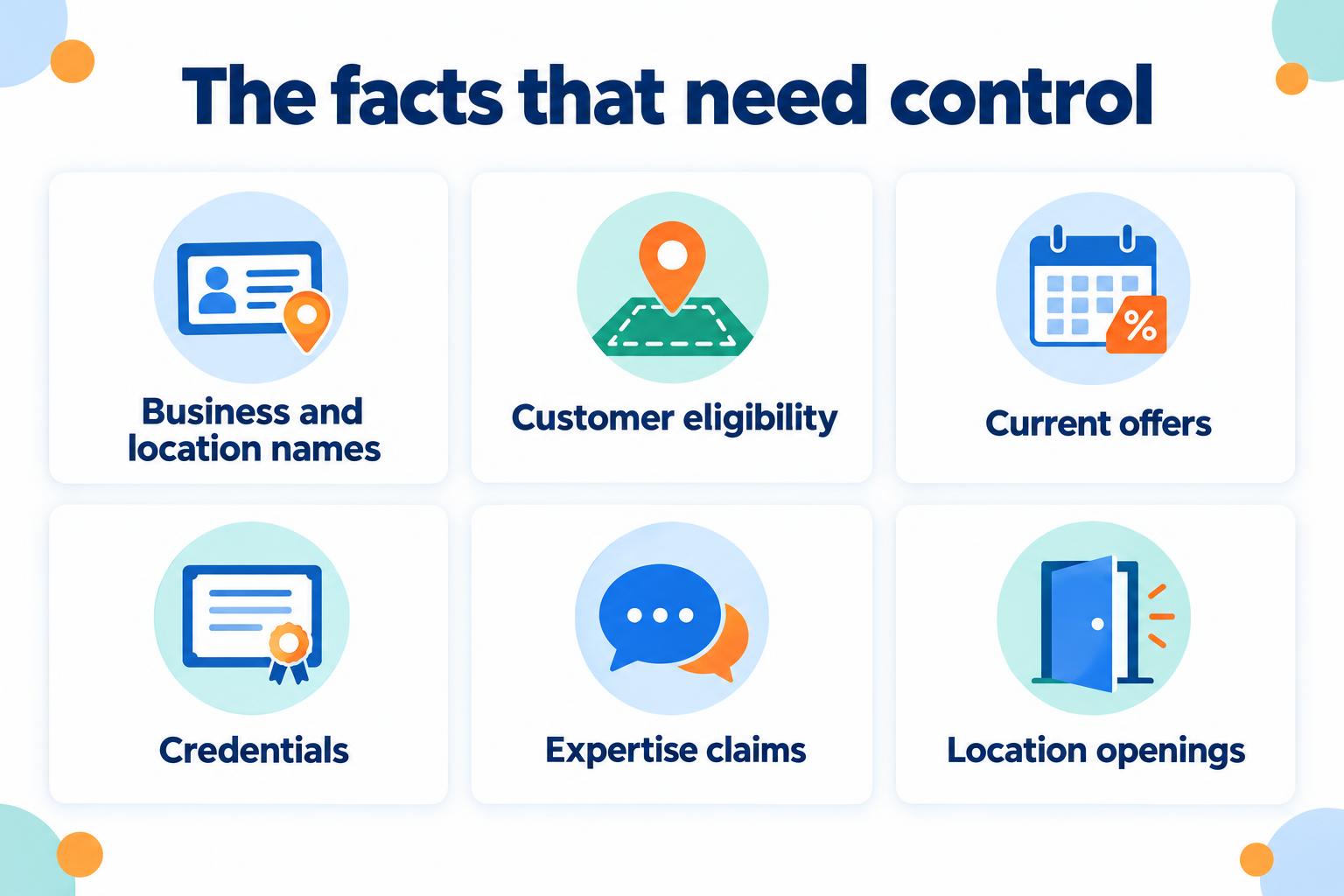
Business information consistency begins with identity and contact details, but it should cover every fact that affects a customer’s decision or an employee’s response.
A working record should account for:
- Business and location names
- Primary and tracking phone numbers
- Office, call-center, and appointment hours
- Services offered by each location
- Service areas and customer eligibility
- Current offers, restrictions, and end dates
- Booking, estimate, and contact links
- Credentials that the business is approved to publish
- Brand descriptions and expertise claims
- Location openings, moves, and closures
Consider a multi-location electrical company that adds generator maintenance at only two branches. Publishing that service on every location page may produce inquiries that other branches cannot fulfill. A home-care franchise faces a similar problem if an approved service description is copied into markets where staffing, authorizations, or operating models differ.
The controlled record must therefore show both shared company facts and legitimate location-level differences.
Information can spread from one platform into another
A single inaccurate field can appear in more places than the person making the edit expects. Google states that location assets in Google Ads can draw information directly from Google Maps and Google Business Profile, including addresses, phone numbers, hours, and media. Corrections made through those linked sources can then flow into the advertising account.
That connection is useful when the source is correct. It becomes risky when a former employee’s number, outdated hours, or closed location remains in the profile.
The website has its own machine-readable layer. Google’s LocalBusiness structured-data documentation supports details such as telephone numbers, location URLs, departments, and opening hours. If the visible location page says one thing while its structured data says another, the business is maintaining two versions of the same fact on one website.
Owners should therefore treat channel relationships as a system, not as separate marketing accounts.
AI tools make source quality more important, not less
AI-generated answers can assemble information from websites and other available sources, but they do not replace the need for accurate source material. OpenAI explains that ChatGPT search can show citations and source links while also warning that search results and citations can be incomplete, outdated, or incorrect.
A service business with an old service page, a current Google profile, and a conflicting directory listing has created several possible answers to the same question. The customer may encounter any of them through search, an AI assistant, or a referral that leads to an older page.
AI content governance is the practical process of controlling the facts used in AI-assisted marketing. A technician recruiting page should not become the source for customer-facing service claims. A limited promotional offer should not remain inside a reusable AI writing brief after it expires.
The safest approach is to give people and tools one approved knowledge source, then require human review before changed facts are published.
One source of truth needs ownership and change rules
A spreadsheet or knowledge system becomes useful only when someone is responsible for maintaining it. Without ownership, it turns into another outdated document competing with the website and profiles.
Start by assigning a business owner for each type of information. Operations may control hours and service boundaries. Leadership may approve expertise and credential language. Marketing may manage channel updates, but it should not independently decide whether a branch offers a regulated, specialized, or newly launched service.
Each record should show the approved fact, where it applies, who approved it, and whether it has an expiration or review condition. An offer tied to a season needs a removal plan. A temporary call-tracking number needs documentation showing which campaign uses it and where calls ultimately route.
InTune Marketing’s Cross-Channel Authority Governance service addresses this need alongside client-specific knowledge systems, workflow integration, and human review and factual quality assurance. The aim is to make approved information usable across the business instead of leaving separate teams to recreate it.
Multi-location businesses need shared rules and location-level exceptions
A franchise or multi-unit operator should standardize the brand without erasing real differences among locations. The corporate description, core service definitions, and approved claims may be shared. Hours, service areas, booking links, offers, and available services may vary by branch.
Google provides bulk Business Profile management for eligible businesses with at least 10 locations. Its documentation also calls for a unique store code for every location so imported changes are applied to the intended profile.
The same principle should carry into the company’s internal records. Each location needs a stable identifier that connects its profile, landing page, call tracking, customer relationship management record, and reporting.
A franchise team should also define which fields local managers may edit. Allowing a manager to update holiday hours is different from allowing that person to rewrite the brand description or add an unsupported credential. Clear permissions protect both local accuracy and company-wide trust.
An audit should follow the customer journey, not just a checklist
The fastest way to find damaging inconsistencies is to act like a prospective customer. Search the company name, a location name, and a core service. Open the website, Business Profile, advertisement, social page, directory listing, and booking path that a customer is likely to see.
Then test the details that affect action. Call the displayed number. Submit the form. Check whether the confirmation message names the right location. Compare office hours with the hours when staff actually answer. Review whether the advertised service appears on the landing page and can be selected in the booking process.
A useful audit also compares internal materials. A dispatcher may use a service-area chart that no longer matches the website. A sales representative may send an old proposal template containing a retired offer. A franchise onboarding folder may give new managers a brand description that was replaced months earlier.
Record each mismatch by source, business impact, owner, and correction status so the audit leads to action rather than another report.
Fix the information closest to revenue and customer trust first
Not every inconsistency has equal business impact. Begin with errors that can send a lead to the wrong place, prevent contact, misrepresent availability, or create a promise the operating team cannot keep.
A disconnected phone number deserves attention before a slightly different company description. Incorrect holiday hours matter more during the affected period than an old team photo. A location page advertising a service the branch cannot deliver should be corrected before stylistic differences in social bios.
Priorities usually fall into a practical order:
- Contact and booking paths
- Open, closed, and special hours
- Location status and service boundaries
- Services and customer eligibility
- Offers, prices, and time limits that the business has approved for publication
- Credentials, expertise claims, and brand descriptions
After correction, check the connected systems rather than assuming one edit solved everything. A Business Profile update may affect linked Google Ads location information, while a website change may require separate updates to structured data, campaign pages, sales templates, and AI knowledge sources.
InTune connects consistency to leads, operations, and measurement
Cross-channel authority governance is most valuable when it reduces business friction, not when it merely produces cleaner documents. InTune Marketing combines cross-channel execution with human-led quality assurance and practical AI integration to help businesses manage approved information across marketing and operating workflows.
Its related services include client-specific knowledge systems, AI visibility measurement, workflow integration, and lead conversion and revenue attribution. Together, these capabilities connect what the business says with how customers respond and how leads move toward booked work.
InTune brings more than 25 years of leadership experience to this work through its Local Authority Engine approach. The focus is a governed foundation that supports customer trust, location consistency, operational efficiency, and meaningful measurement without reducing the problem to prompt writing or a single marketing channel.
If conflicting business information is creating rework, customer confusion, or weak lead tracking, Schedule a strategy consultation to map the sources that need one governed answer.
Frequently Asked Questions
Does every marketing channel need to use exactly the same wording?
No. The core fact should remain consistent, but the wording can fit the channel and customer’s stage. A short Google profile service description may differ from a detailed website page, while both must agree on whether the service is available, which location provides it, and how the customer books it.
Can a business use different phone numbers for advertising and call tracking?
Yes, provided the numbers are deliberately mapped and tested. Document the channel, campaign, destination, responsible vendor, and fallback number. Test routing after campaign changes so a tracking number does not continue sending callers to a former agency, closed branch, or unattended line.
Who should approve changes to business information?
Approval should follow the type of fact. Operations should confirm service areas and availability, location leadership should verify hours and contact routes, and an authorized leader should approve credentials or expertise claims. Marketing can publish the change after the responsible owner confirms it.
Should franchise locations be allowed to create their own offers?
That depends on the franchise rules and the location’s authority. If local offers are permitted, use a required template with an approved service, eligible location, start and end conditions, redemption process, and removal owner. That keeps a local promotion from becoming an accidental company-wide promise.
How should temporary closures or seasonal hours be managed?
Record the affected location, exact operating change, effective dates, approval owner, and every channel requiring an update. Assign a second task to restore normal information afterward; otherwise a temporary change can remain visible on profiles, landing pages, voicemail, and automated messages.
What is the difference between a knowledge system and authority governance?
A knowledge system stores approved business facts so employees and tools can find them. Authority governance defines who may approve those facts, where they can be used, how exceptions are handled, and what happens when information changes. Most growing service businesses need both storage and control.