




Local search reporting can create the wrong impression when one number receives too much attention.
A recent home service client provides a useful example.
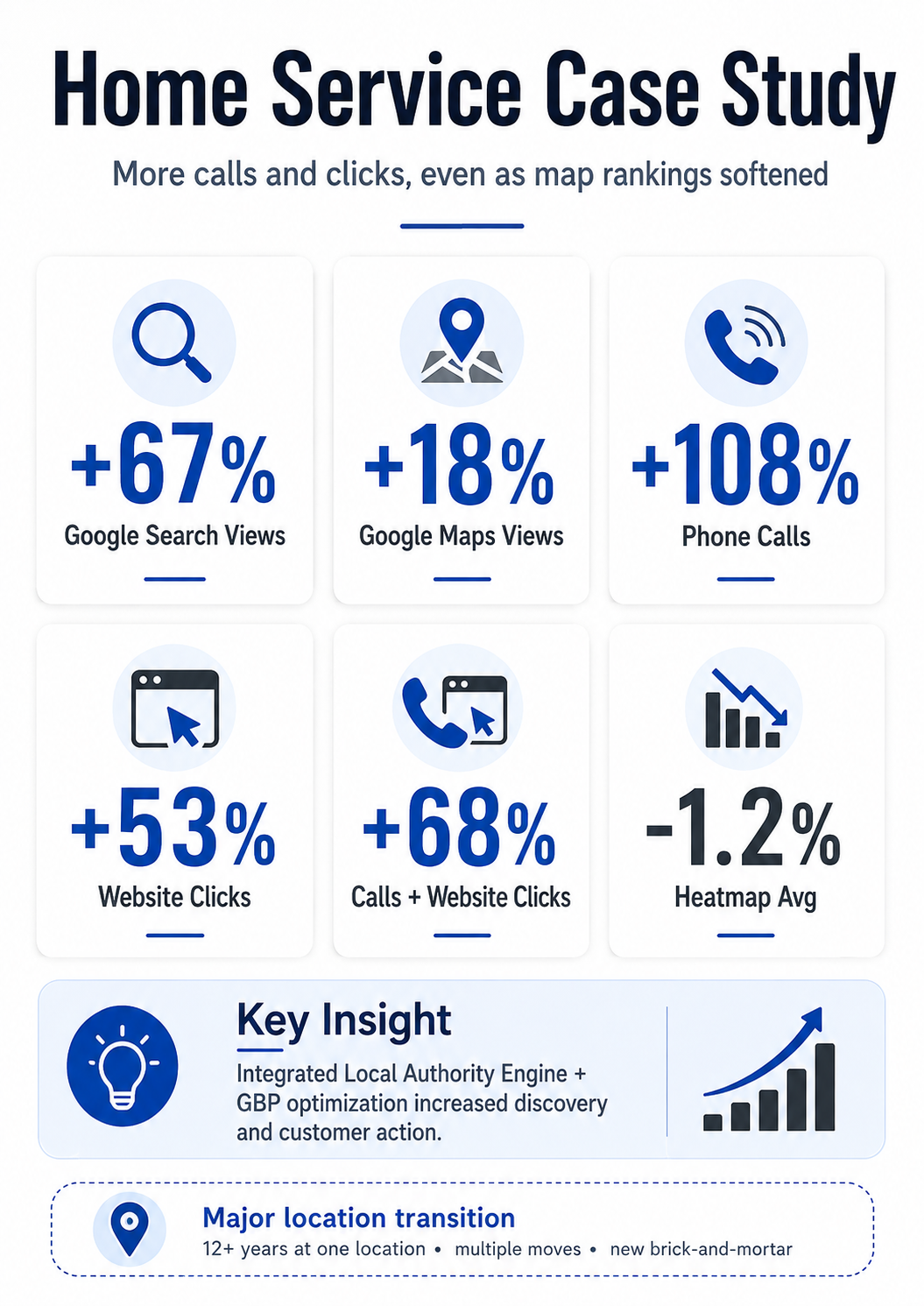
Its overall geographic map-ranking average declined approximately 1.2% during the reporting period.
If we stopped there, we might conclude that local performance had weakened.
But the customer data showed something very different.
During the same period:
- Google Search visibility increased 67%
- Google Maps visibility increased 18%
- Phone calls increased 108%
- Website clicks increased 53%
- Calls and website clicks combined increased approximately 68%
The situation becomes even more interesting because this business was working through a major location transition.
After operating from the same physical location for more than 12 years, the company moved several times over approximately eight months before finally establishing a new permanent brick-and-mortar location.
For any local business, that is significant.
For a company that serves customers across a large service area, it creates an even more complicated local-search problem.
The results reinforce something we believe strongly at InTune Marketing:
Home service businesses need to measure the entire local discovery and conversion system, not one ranking report.
A Difficult Local Search Situation
For confidentiality, we are keeping the client’s identity and specific service category anonymous.
The company is an established home service business serving multiple communities throughout its market.
Its customers generally do not visit the company to purchase services.
The company goes to them.
That distinction affects how we measure success.
Calls matter.
Website visits matter.
Service requests matter.
A direction request has value, but for this type of business, it is usually less meaningful than a customer who calls to discuss a project.
The company was also dealing with an unusual local-search challenge.
It had spent more than 12 years at one established location before beginning a period of relocation.
During the following eight months, it moved multiple times before finally settling into a new brick-and-mortar location.
Meanwhile, the company still needed Google to understand where it was, what it offered, and which communities it served.
Why Moving Locations Matters
Location is a major part of local search.
That does not mean a change of address automatically destroys visibility, but repeated changes can make local optimization considerably more complicated.
A business that has spent more than a decade operating from one location has accumulated years of local history around that address.
When the location changes multiple times within a short period, the business must rebuild consistency around its new location while continuing to compete for customers throughout the existing service area.
That was the environment in which we were working.
It also meant we did not want to make the mistake of treating the Google Business Profile as a standalone marketing channel.
Our Broader Local Authority Strategy
InTune Marketing was supporting the company through an integrated Local Authority Engine strategy.
Google Business Profile optimization was an important part of that work, but it was connected to broader authority development across:
- The company’s website
- Localized service content
- Customer-focused educational articles
- Social content
- Internal website linking
- Geographic relevance
- Ongoing Google Business Profile posts and imagery
The goal was to strengthen the relationship between the business, the services it provides, and the communities it serves.
This is fundamentally different from simply publishing occasional GBP posts and waiting for map rankings to change.
The strategy builds a larger body of supporting content and local relevance around the business.
What Happened During the Reporting Period
The most obvious improvement was visibility.
Google Search views increased to 962, a 67% increase.
Google Maps views increased to 862, an 18% increase.
Search visibility therefore increased substantially faster than Maps visibility.
That difference is important.
Customers do not necessarily discover a local service business in one predictable way.
They may begin in Google Search.
They may encounter the company’s Business Profile.
They may click through to the website.
They may read an article.
They may evaluate services or reviews.
Then they may call.
Good local marketing supports that entire process.
The Number That Stood Out: Calls Increased 108%
Phone calls increased from:
13 during the previous period
to:
27 during the current period
That is a 108% increase.
For a home service company, this is difficult to ignore.
More people were finding the business and taking one of the strongest possible actions available through the Google Business Profile.
They were calling.
Fourteen additional calls were generated compared with the previous period.
That occurred even though the average heatmap ranking softened slightly.
This is why we do not believe ranking reports should be evaluated without conversion data.
Website Clicks Increased 53%
Website clicks increased from:
34 to 52
That is a 53% increase.
For a home service provider, this is another strong signal of customer intent.
Customers frequently need more information before making contact.
The website allows them to evaluate the business beyond the small amount of information available within a search result.
This is also why authority-based website content matters.
If Google sends more people to the site, the site needs to give those visitors useful reasons to continue considering the company.
Combined High-Intent Actions Increased About 68%
When we combine phone calls and website clicks, the change becomes even clearer.
The previous period produced:
47 combined calls and website clicks.
The current period produced:
79.
That is approximately a:
68% increase in high-intent actions
This is one of the metrics we find most useful in this particular case.
Map rankings tell us about search visibility.
Calls and clicks show us how people responded to that visibility.
What About the Decline in Direction Requests?
Direction requests decreased from:
62 to 43
a decline of approximately 31%.
For some businesses, that would be an important negative result.
For this type of home service company, we interpret it differently.
The customer does not typically need to drive to the company.
The company serves the customer at their property.
At the same time that direction requests declined:
- Calls increased by 14
- Website clicks increased by 18
That means there were 32 additional calls and website visits.
From a lead-generation standpoint, that change in customer behavior is significant.
The Map Rankings Were More Complicated Than the Average
The overall heatmap moved from an average of:
14.6 to 14.8
The report measured that as a 1.2% decline.
That sounds negative until we examine the actual keyword performance.
One important broad commercial term improved from an average ranking of 8.85 to 7.79.
Its top-three geographic coverage increased from 33.14% to 39.64%.
Another core commercial term improved its top-three coverage from approximately 27.22% to 32.54%.
Other searches weakened.
Some geographic areas remained difficult.
That mixture produced the slight overall decline.
In other words, the heatmap was not telling us that every important search term had lost visibility.
It was showing uneven geographic performance across a larger set of searches.
The Location Transition Makes the Results More Meaningful
This is where the client’s circumstances become especially relevant.
The business had not been operating from a stable location throughout this process.
After more than 12 years in one place, it moved multiple times over an eight-month period.
It had only recently established its new permanent brick-and-mortar location.
That means the local search program was operating while one of the company’s most important geographic signals was changing.
Against that backdrop, we believe it is especially important to distinguish between temporary geographic-ranking volatility and actual commercial performance.
During that period of instability, customers were still discovering the business at significantly higher rates.
And substantially more of them were taking action.
Google Business Profile Optimization Was Only Part of the Work
The Business Profile received consistent optimization activity throughout the reporting period.
The activity log shows repeated posts, image uploads, FAQ generation, and profile maintenance.
But this was not a GBP-only campaign.
At the same time, we were supporting the company with Local Authority Engine content across the website and social channels.
That means the business was building authority through multiple connected touchpoints.
We cannot responsibly say that one specific piece of content caused a 108% increase in calls.
The report does not prove that.
What we can say is that the performance occurred while a coordinated authority strategy was being deployed across the business’s local digital presence.
That is an important distinction.
Rankings Are Part of the Story, Not the Entire Story
Many businesses have been trained to ask one question about local SEO:
What position are we in?
That is still worth tracking.
But local search has become more complex.
For a service-area business, visibility can differ dramatically by searcher location.
One neighborhood may show strong rankings while another shows weaker performance.
A customer may find the company through Search instead of Maps.
Another may click directly to the website.
Some people may never request directions because they do not need to visit the business.
If the reporting stops with an average map number, those behaviors disappear from the analysis.
What We Would Tell Another Home Service Business
If your local rankings fluctuate, do not ignore them.
Investigate why.
Look at the affected services.
Look at geography.
Look at competitors.
But do not assume that a modest ranking decline automatically means the entire marketing program is performing poorly.
Look at what customers are doing.
Are more people seeing the business?
Are they visiting the website?
Are calls increasing?
Are qualified inquiries increasing?
Those metrics help determine whether visibility is producing commercial value.
Why We Use Local Authority Engine
At InTune Marketing, we use Local Authority Engine because we believe local visibility should be built as a connected system.
A strong Google Business Profile matters.
So does the website behind it.
So does the content that explains the company’s expertise.
So does geographic relevance.
So does the consistency of the information being published around priority services and communities.
The goal is to create a stronger relationship between the company and the subjects customers are searching for.
That gives search engines more context.
It also gives customers more information when deciding which company to contact.
What We Are Focusing on Next
The report still identified opportunities.
Several service-specific and geographic searches remained weaker than we want them to be.
Those findings help determine the next phase of the work.
We can use future content and GBP optimization to strengthen:
- Underperforming service categories
- Priority communities
- Weaker service-and-location combinations
- Local customer questions
- Supporting website authority
- Geographic consistency around the new permanent location
The objective is to continue expanding map visibility without losing sight of the larger commercial result.
The Bigger Takeaway
This business had operated from one location for more than 12 years.
Then it moved multiple times within eight months.
Its geographic search presence was still stabilizing.
Its average heatmap ranking declined slightly.
Yet in one reporting period:
Google Search visibility increased 67%.
Google Maps visibility increased 18%.
Website clicks increased 53%.
Phone calls increased 108%.
Combined calls and website clicks increased approximately 68%.
Those figures come directly from the reporting data.
For us, the lesson is straightforward.
A home service business should absolutely care where it ranks.
But the ultimate objective is not a ranking report.
It is being found by the right people and giving more of them a reason to become customers.
That is why Google Business Profile optimization works best when it is connected to the larger authority strategy surrounding the business.